


Robert B. Asprey. Frederick the Great: The Magnificent Enigma Ticknor and Fields, New York, 1986.
* A lively account of Frederick, focusing more on the soldier and politician than the philosopher and gadabout (for THAT Frederick, take a look at MacDonogh or Wilhelmina's memoirs).

Sarah Knowles Bolton. Famous English Statesmen of Queen Victoria's Reign Thomas Crowell, New York, 1891.
* The book that made the seventh Lord Shaftesbury and Henry Fawcett into like my favorite historical dudes ever. Takes Palmerston a LITTLE too much at his own word, but otherwise a nice selection of men working to benefit the ordinary folk of 19th century England.

J. Franck Bright. Joseph II. Kennikat Press, New York, 1897.
* They reissued this fellow in 1970 in limited supply. A rather cold and dull book, but one of the only ones around dealing specifically with Austrian Emperor Joseph II. For a warmer account, take a look at A.W. Thayer’s biography of Salieri. - DvL

Paul Cartledge. Alexander the Great The Overlook Press, New York, 2004.
* There's a lot of smack talked about Cartledge out there by the, you know, six guys on the internet who earnestly discuss their favorite Alexander biographies. But it's a good mix - there's the military stuff in there, though not to the degree of say Fuller. There's character speculation, but not an absurd amount. And, what's best, there's some good context in terms of what the Other Greek city-states of the day were up to as part of their normal routine of stabbing each other in the back every ten years or so.

Shelby Foote. The Civil War: A Narrative Vintage Books, New York, 1986.
* This series is so good that every second you spend reading this write-up and not reading the actual books is actually doing serious harm to the overall quality of your life. It's also about 3,000 pages, so you best get going.

James R. Gaines. Evening in the Palace of Reason: Bach Meets Frederick the Great in the Age of Enlightenment. Harper Perennial, 2006.
* An interesting story pretty well ruined by Gaines’s endless moralizing and general cutesiness. If you just read for the story and don’t pay too much heed to his musico-religious theories, it’s worth a checkout from the library. - DvL
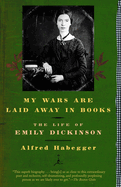
Alfred Habegger. My Wars are Laid Away in Books: The Life of Emily Dickinson. The Modern Library, New York, 2001.
* Emily Dickinson scholarship is a battlefield, filled with people who have largely made up their minds about who Emily Dickinson should be, and who cherrypick the record to make that portrait fit. Habegger largely avoids all of this and instead produces a deeply, deeply researched and also very beautiful account of the poet's life. Her brilliant sense of humor, her deep love of family and friends, and her complicated private life are all rendered with sympathy and understanding.

Juliane Haubold-Stolle. Oma ist die Beste: Eine Kulturgeschichte der Oma Verlangenheits Verlag, Berlin, 2009.
* A cultural history of grandmothers, with some beautifully illuminated corners populated with elderly women changing the way their societies view age and gender, along with a fascinating broader look at the separate development of gender politics in West and East Berlin after the Second World War. Grandmother has not always been grandma, it turns out.
E.A. Brayley Hodgetts. The Life of Catherine the Great of Russia. Methuen & Co.,
London, 1914.
* Hodgetts attempted to resurrect Catherine’s reputation after the 19th century had exhausted its energies lodging her firmly under a horse. Not much about foreign policy in here, but a good deal about the person. - DvL

Charles W. Ingrao. The Habsburg Monarchy: 1618-1815. Cambridge University Press, Cambridge, 1994.
* Cuts the Habsburgs some slack, but still goes into a fair amount of detail about the constant, unending missteps of these, the Steve Urkels, of the European scene. - DvL

Henry Kamen. Philip of Spain. Yale University Press, New Haven, 1997.
* Valiantly attempts to remove the Black Hat from Philip's brow, and while, on the personal level, you like the fellow a bit more than you expected, and give him more props as a diligent administrator, the attempts to save his decisions as regards the Netherlands, Portugal, England, and the general theme of intellectual and religious freedom for people unfortunate enough to live in his lands, doesn't come off as entirely convincing. Still, a detailed and highly interesting book from a viewpoint hard to find in the English language.

Robert Lacey. Great Tales from English History: The Truth About King Arthur, Lady Godiva, Richard the Lionheart, and More. Little, Brown, and Company, London, 2004.
* Want to read Boudica's story without fifty pages of analysis as to why it is actually nothing more than a Narrative of Phallocratic Otherhood? Lacey's your man. This is the first in a three volume set of incredibly engaging historical bon bons. Just good fun. - DvL

Alan Lloyd. The King Who Lost America: A Portrait of the Life and Times of George III: A Highly Entertaining Portrait of the Rather Endearing Prig Who Lost the Colonies Doubleday, New York, 1971.
* One of the few works of history that I could just NOT STOP READING. It has fun with its subject without trivializing it, points out tragedy without using it as rationalization, and is, at every turn, entirely HUMAN. And that's rare.

Giles MacDonogh. Frederick the Great: A Life in Deed and Letters. St. Martin’s Griffin, New York, 1999.
* A fine book for those seeking the philosopher and not so much the soldier. Not worshipful like Mitford, but also not the “He’s A Proto-Nazi!” hysteria of some scholars. - DvL

Felix Markham. Napoleon New American Library, New York, 1966.
* A brief (266 pages) and entirely good introduction to Napoleon, his campaigns, and domestic policies. No real extensive analysis of his character, which is probably why this book is still in print while other, more PSYCHOLOGICAL, biographies have come and gone. Tickles the Napoleon As Hero centers of your brain (and you know you have them).

Robert K. Massie. Peter the Great: His Life and World. Ballantine Books, New York, 1980.
* A titanic book with possibly the best description of the use of dwarves in eighteenth century court life yet written. Interspersed throughout are not only fantastic stories about Peter, but also nicely developed biographies of William of Orange, Charles XII, and the Duke of Marlborough. A one-stop shop for the late seventeenth and early eighteenth centuries. - DvL

W.W. Meissner. Ignatius of Loyola: The Psychology of a Saint. Yale University Press, New Haven, 1992.
* There is some good stuff in here, but for every page of it there are eight pages of repetitive, classification obsessed, and not particularly fruitful psychoanalysis. Unlike other biographies, though, it considers the possibility that Ignatius was just a regular dude with huge problems, and not a manifestation of God's will on Earth.
Jean Baptiste de la Mettrie. Man, a Machine. Open Court Publishing, Chicago, 1912.
* de La Mettrie was one of Frederick’s close friends who went on to die at the hands of paté. This is his big philosophical work proposing exactly what the title suggests. His science gets downright silly, but there are enough daring points in there to make it worth a gander. - DvL

Ellen Moers. The Dandy: Brummell to Beerbohm University of Nebraska Press, Lincoln, 1960.
* What was Disraeli like as a Dandy? What set apart a Baudelaire from a Brummell? Is there anything at all redeeming about George IV? A wonderful sourcebook for all things Regency and in general sartorial.
Radha Kumud Mookerji. Chandragupta Maurya and his Times Motilal Banarsidass Publishers, Delhi, 1966.
* Those reading Plutarch might wonder to themselves, "Gosh, whatever became of that bright Androcottus chap?" And this book will tell you everything you could possibly want to know. Doesn't read as a narrative, but rather as a series of detached headings under which is listed the relevant information. Like a little Chandragupta encyclopedia!

John Morley. The Life of Gladstone (3 vols) The Macmillan Company, Norwood, 1903.
* Do you want to know about the repeal of the Corn Laws? No, REAAAAALLY want to know about them? Put together, Morley's Gladstone biography weighs in at 1800 pages, a good third of which is him quoting, extensively, for pages and pages at a time, from Gladstone's factual and proper diaries. Still, you get a very full sense of the turmoil and soul-searching Gladstone went through as he fought his way mentally from son of an unrepentant plantation lord to champion of intellectual and political freedom.

John Richardson. Picasso: The Cubist Rebel, 1907-1916. Knopf, 2007.
*A book about a terrible human being written by, as far as I can tell, another terrible human being. There is a certain amount of poisoning of the soul that goes with reading Richardson's Picasso books. You just feel bad after each session, watching Picasso on the hunt for new mistresses as his current one is dying of cancer, with Richardson's all-encompassing defense being "He was Spanish - he HAD to!" (Seriously) But there's a fun drinking game that goes with it - namely to do a shot each time Richardson uses the word "ingenious" when "juvenile" would be more appropriate. But, there is no doubt that, by the time you're through, you'll know things about Picasso and the artistic circles in which he moved that you would not learn otherwise. The ratio of "Wow, that's interesting" to "Wow, you're an awful misogynistic douchebag, John Richardson" is about one to two. Tough, but doable.

James Romm, editor. Alexander the Great: Selections from Arrian, Diodorus, Plutarch, and Quintus Curtius Hacket Publishing, Indianapolis, 2005.
* A stitching together of the best sources we currently have, good to fill the gaps for those of us who have nice sets of Arrian and Plutarch lying about but don't happen to have Diodorus ready at hand

Carl Sandburg. Abraham Lincoln: The Prairie Years and The War Years Dell Publishing, New York, 1959. * Perhaps the best historical biography ever written for grandeur and sheer readability. It was originally published back in 1925, but I'm listing the 1959 reprint that came in three pocket-sized volumes pared down by Sandburg himself. It's highly portable and still highly awesome. Anyway, there are more historically rigorous biographies out there, but none written by somebody who actually seems to understand viscerally the world Lincoln came from, the tall tales and humorous yarns that were woven across often dire circumstance. Sandburg taps into that like nobody else, and so we'll always come back to him in the end.

Alan Schom. Napoleon Bonaparte HarperCollins, New York, 1997.
* A far less brief (787 pages) account of Napoleon, which has as its central thesis: "Napoleon Bonaparte was a fuck-up." Sometimes, as with the Invasion of Britain or Egypt, this thesis is entirely plausible. Other times, minor points seem to be stretched and major virtues overlooked in order to keep everything fitting in the Big Picture. Still, if you want to move from Hero Worship to Balanced Respect, this book will get you there.

Lytton Strachey. Eminent Victorians Harcourt, Brace, and Co., New York, 1918.
*Short accounts of the lives of Florence Nightingale, General Gordon, Cardinal Manning, Dr. Arnold. Strachey is always fun to read, and the account of Gordon is told in the best "Brit pulling a stiff upper lip as a tiger makes off with his leg" tradition.

Lytton Strachey. Queen Victoria Harcourt, Brace, and Co., New York, 1921.
* More accurately Some British Prime Ministers, Prince Albert, and Incidentally Queen Victoria but still, a classic read in the realm of historical biography glittering with life and wry observations on the foibles of the Victorians.

Henri Troyat. Ivan the Terrible. Dorset Press, New York, 1984.
* A great, if horrifying, book, that I think I literally read in two settings as each atrocity built on itself and you just sit in your chair wondering How Much More Messed Up things can get and then, sure enough, five pages later, Ivan has found some new horrendous way of shucking men of their skins... Troyat is wonderfully readable, and the bibliography is a treasure trove for those looking for more early Russian history.
Victor Thaddeus. Voltaire: Genius of Mockery. Brentano’s, New York, 1928.
* To tell the truth, I haven’t read this fellow in well-nigh-on ten years. I remember loving it at the time, though. – DvL

Peter A. Wallner. Franklin Pierce: New Hampshire's Favorite Son and Franklin Pierce: Martyr for the Union. Plaidswede Publishing, Concord, 2005 and 2007.
* A highly sympathetic two volume account of Franklin Pierce's life. And he's right - Pierce deserves another look. Pierce lived tragically, the victim of his own sense of honesty and fair play in the political arena, which cost him all of the friends he ever made, and of his own inability to prioritize the human suffering of slavery above his rigid conception of constitutional legality. If you read only one double volume set chronicling the life of the fourteenth president of the United States, make it this one!

C.V. Wedgwood. William the Silent: Prince of Orange Yale University Press, New Haven, 1944.
* I LOVE C.V. Wedgwood. Every line hums with this engaging love of the foibles and virtues of her subjects that is apart from them but not, like others who find themselves to be Very Clever, self-aggrandizing or subject-diminishing. They are people, and she finds them irresistible, and it shines through the page. Her book on William the Silent is a lovely testament to one of the great figures of 16th century European history.

Francis Wheen. Karl Marx: A Life W.W. Norton & Co, London, 1999.
* There are A FEW Karl Marx biographies out there. A good number of them are just polemics for one side or the other, particularly those published here in The States. Isaiah Berlin's Karl Marx: His Life and Environment is a great one for intellectual history nerds, but it's also 50 years old. Wheen has the benefit of that half-century of research, and the quieting down of the Cold War, allowing him to present an up-to-date case for the intellectual importance of Marx that mixes his faults with his insights in a balanced and compelling fashion that you can read to learn things from, rather than to Form An Opinion. The bits about Kapital in particular are worth it for those trying to wrap their heads around that work.


E. T. Bell. Men of Mathematics: The Lives and Achievements of the Great Mathematicians from Zeno to Poincaré. Simon and Schuster, New York, 1937.
* For my money, still the best book of mathematical biography out there. – DvL

Richard Feynman. Surely You’re Joking, Mr. Feynman! Adventures of a Curious Character. Bantam Books, New York, 1985
* There is a direct path from me reading this book in seventh grade to me sitting here typing these words. The latter is inconceivable without the former. – DvL

James Gleick. Isaac Newton. Vintage Books, New York, 2003.
* On the brief side, but gives you a good, vibrant sense of the men who founded the Royal Society and as such the modern scientific community. - DvL

John Gribbin. The Fellowship: Gilbert, Bacon, Harvey, Wren, Newton and the Story of a Scientific Revolution. Overlook Press, New York, 2005.
* I owe a lot to John Gribbin. In seventh grade, it was his In Search of Schroedinger's Cat which got me interested in modern physics. His style is clear and delightful without being "Hey, going into details is so lame, kids, but I'm cool, right?" like so many others who write about science for wider consumption. Plus, it's nice to have an accessible volume on the shelf with good detailed accounts of Newton and Galileo's predecessors and colleagues, especially Gilbert and Harvey. He also takes pain to give Hooke due credit for his work with the Royal Society, correctly pointing out how Newton got his notion of planetary motion being straight line inertia being deflected by a centripetal force from Hooke, but then incorrectly (as Hooke's biographer Inwood has shown) states that Newton also got the idea of the inverse square law from Hooke. Other than that, good times! - DvL

A. Rupert Hall. From Galileo to Newton. Harper and Row, New York, 1963.
* Another classic in the history of science. No huge surprises, but no ludicrous attempts to portray Newton as a closet puppy strangler either. - DvL

Stephen Inwood. The Forgotten Genius: The Biography of Robert Hooke 1635-1703. MacAdam/Cage, 2003, San Francisco.
* Robert Hooke was due for a re-evaluation, and this is a lovely one which doesn't try and deny the oversensitive and often too prolific for his own good nature of the man, but which balances it with a thorough account of his massive output (how many other people were arguing for massive tectonic change in the earth and species extinction and adaptation in the 17th century - let alone who also happened to give Newton a critical piece in formulating gravity theory, discovering new effects of pressure and light, and improving exponentially basically every single instrument of scientific investigation then known to man?) as well as his active social life with all strata of British society.
- DvL

Pietro Redondi. Galileo: Heretic. Princeton University Press, Princeton, 1987.
* Does a great job not only with bringing Galileo to life, but the highly unique intellectual atmosphere of his day. - DvL
